01
Scale
A large plant has thousands of isometrics and tens of thousands of welded joints. Construction takes years, and several contractors work on site at the same time.
PipeQC · piping quality control PipeQC product
PipeQC follows a pipeline from drawing to test. You can see who welded a joint, under which procedure, what inspection found and what still blocks the test.
01 · How a plant is built
A refinery, a gas complex, a chemical plant, a power station. Steam, gas, oil and acids run through their pipes under pressure. Without the pipes, the equipment just stands there.
01
A large plant has thousands of isometrics and tens of thousands of welded joints. Construction takes years, and several contractors work on site at the same time.
02
A weld cannot be taken apart and remade after start-up. So every joint needs a passport: who welded it, under which procedure, and what inspection found. It is kept for decades.
03
The fluid in the pipe determines the steel, the wall thickness and the share of joints sent for non-destructive testing. On water, a sample is checked; on a hazardous medium, every joint.
02 · Detailed pipe journey
On the left is an isometric of a single line. Scroll down — at each stage the drawing updates just like the line record in the system.
01 · Isometric
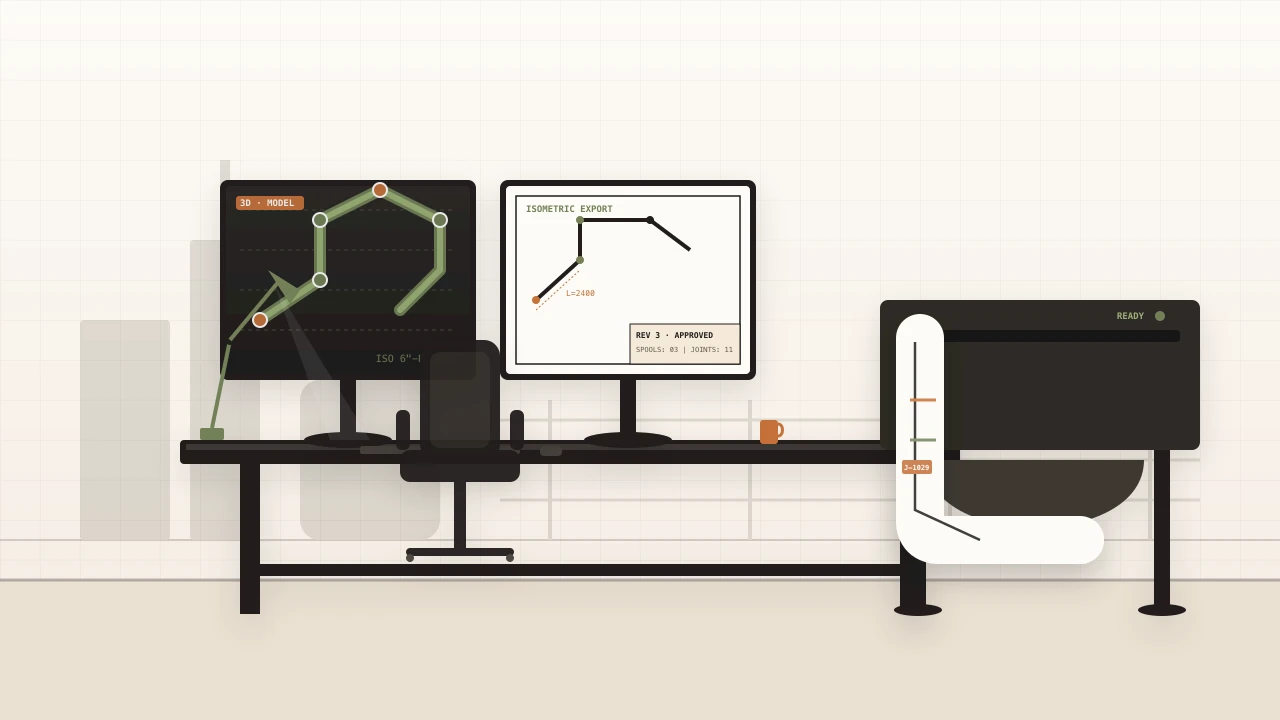
Designers issue an isometric drawing for construction — the path of a single line from pump to heat exchanger. Every straight run, elbow, tee and flange is numbered, with a bill of materials at the bottom. A medium plant requires thousands of these drawings.
On drawing. Line 6"-P-2041-A1: joints J-01…J-11 and flange FL-03. So far, it is only a drawing.
02 · Spooling
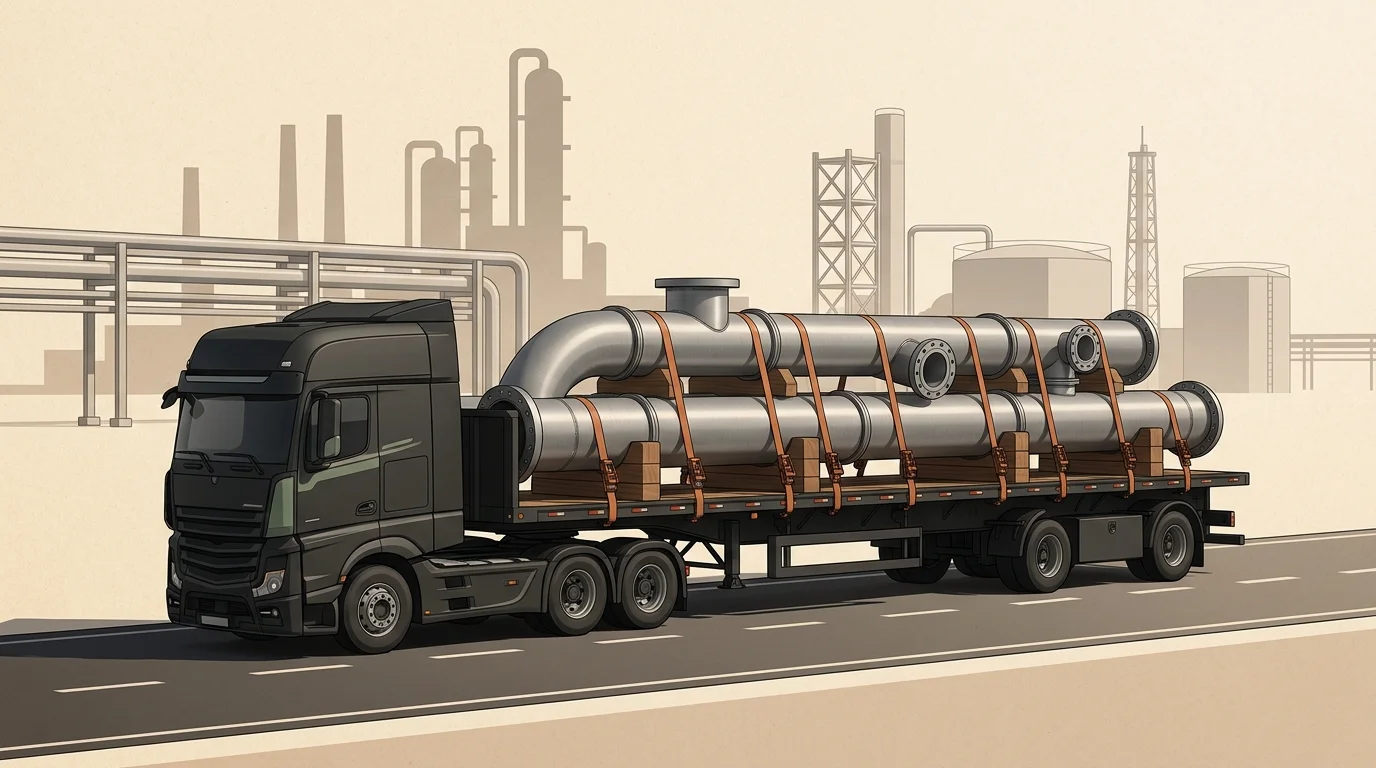
A spool is a pipe section pre-assembled in the shop that fits on a standard flatbed. The cut between spools becomes a field joint welded on site. The more welds completed in the shop, the safer and cheaper the construction.
On drawing. The line is cut into three spools SP-01, SP-02, SP-03. Joint FW-07 becomes a field joint.
03 · Shop
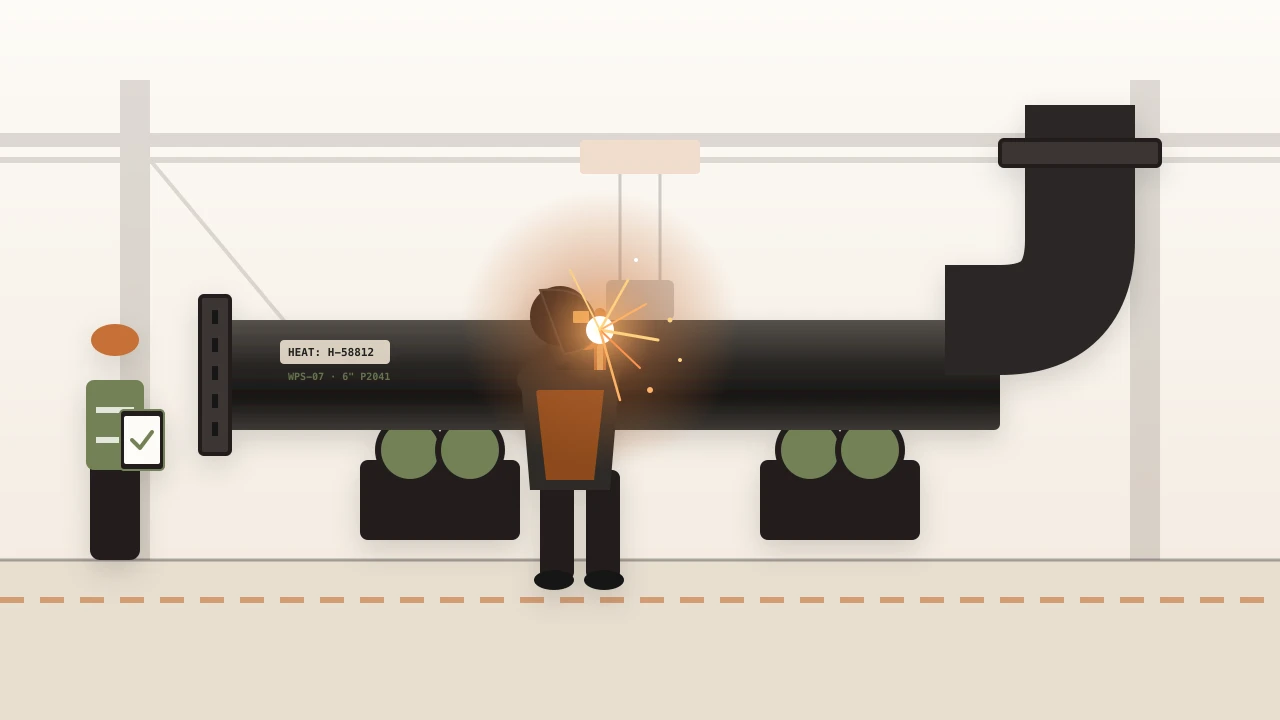
Materials are verified by heat number — pipe and fittings must match project specifications. Only welders with valid qualifications for this procedure may weld. Every weld is inspected, and PWHT is performed if required.
On drawing. SP-01 and SP-02 are fabricated, SP-03 is in progress. Welder and WPS are recorded for each joint.
04 · Inspection
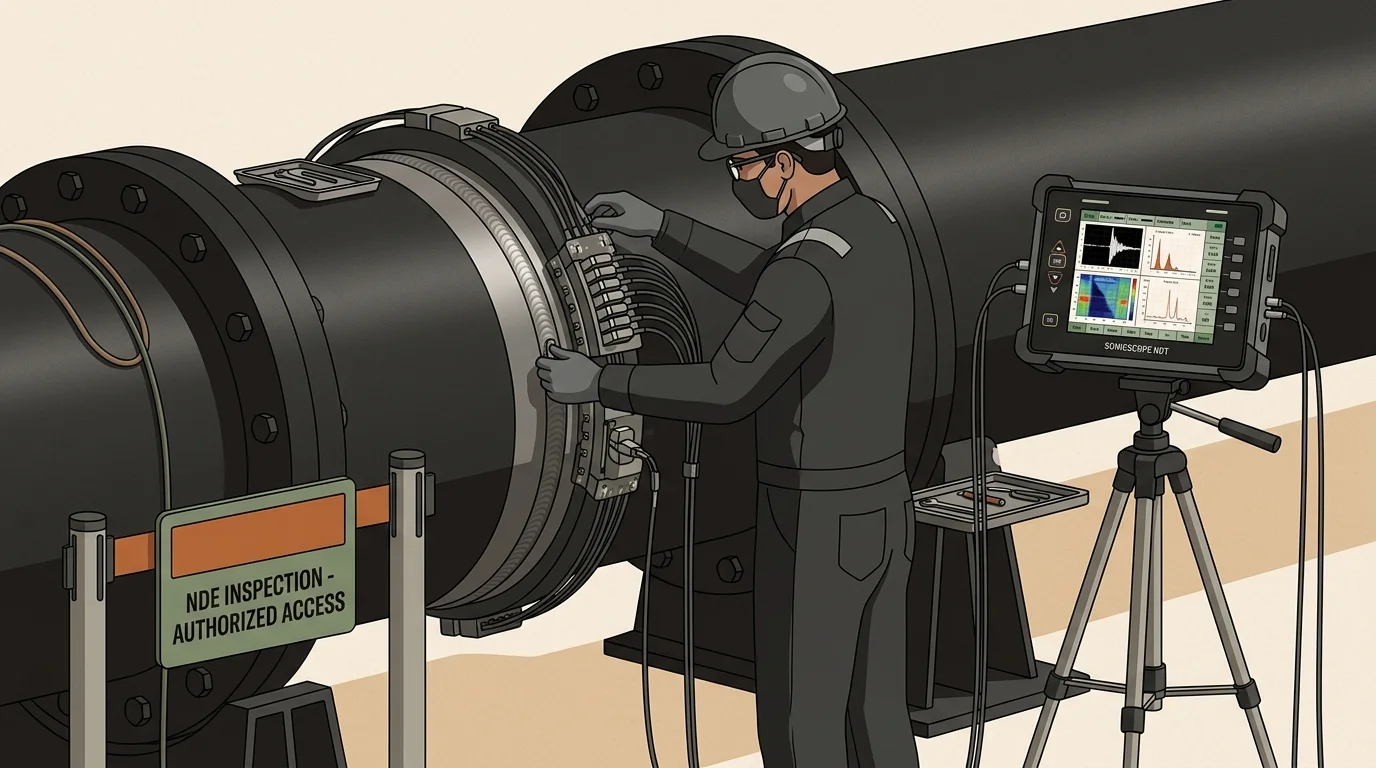
The weld is inspected non-destructively by radiography or ultrasound. The percentage of joints tested is dictated by the medium class, from random sampling to 100%. Each welder has a unique stamp, so inspection directly traces who welded it.
On drawing. J-02 and J-05 are accepted. J-1029 failed RT, and the system automatically assigned a repair and two penalty tracers — J-11 and J-01, joints of the same welder.
05 · Erection
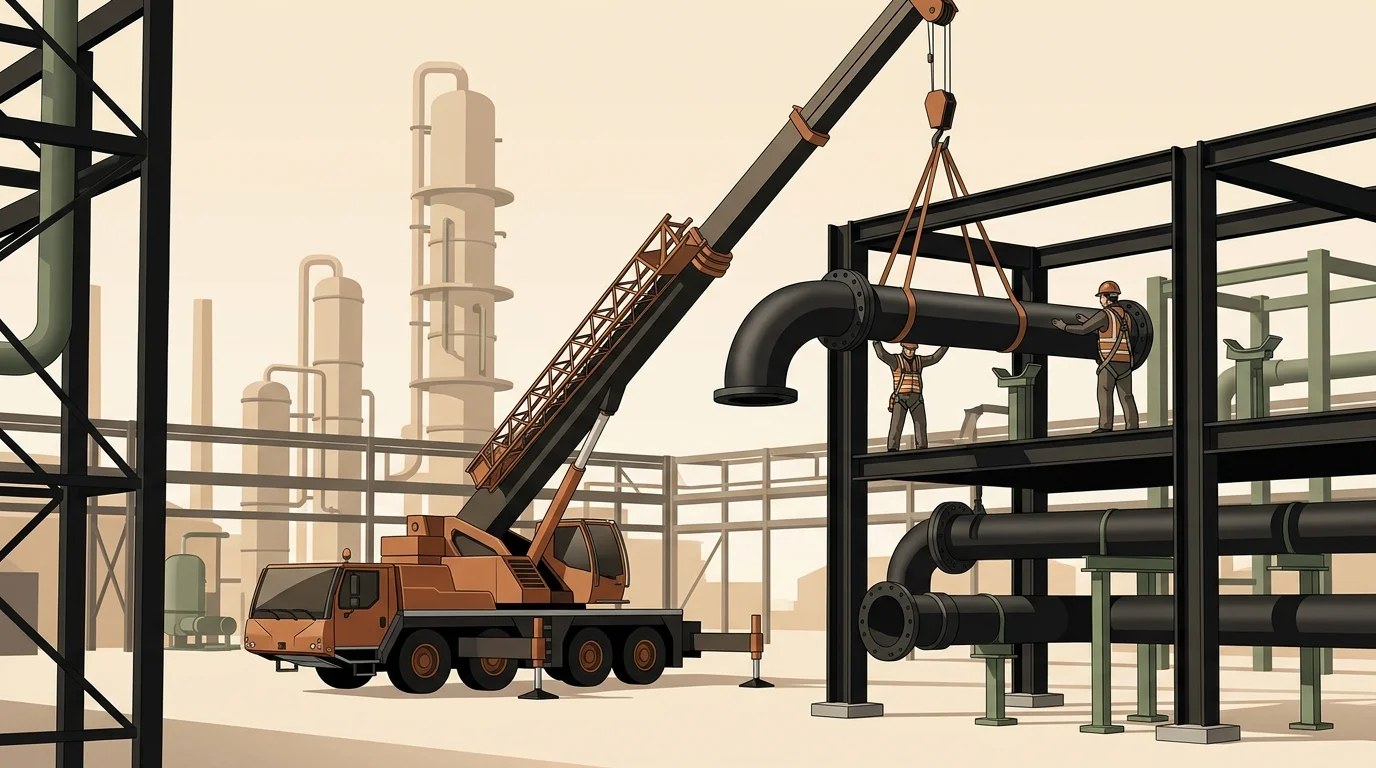
Spools are hauled to the site, hoisted by cranes, and set onto pipe racks. Field joints are welded at height in any weather — driving up cost and risk. Flanges are torqued, and an inspector walks the line logging punch items.
On drawing. Field joint FW-07 is welded, J-1029 is accepted after repair. Flange FL-03 lacks a torque record — the line is not ready for testing yet.
06 · Testing
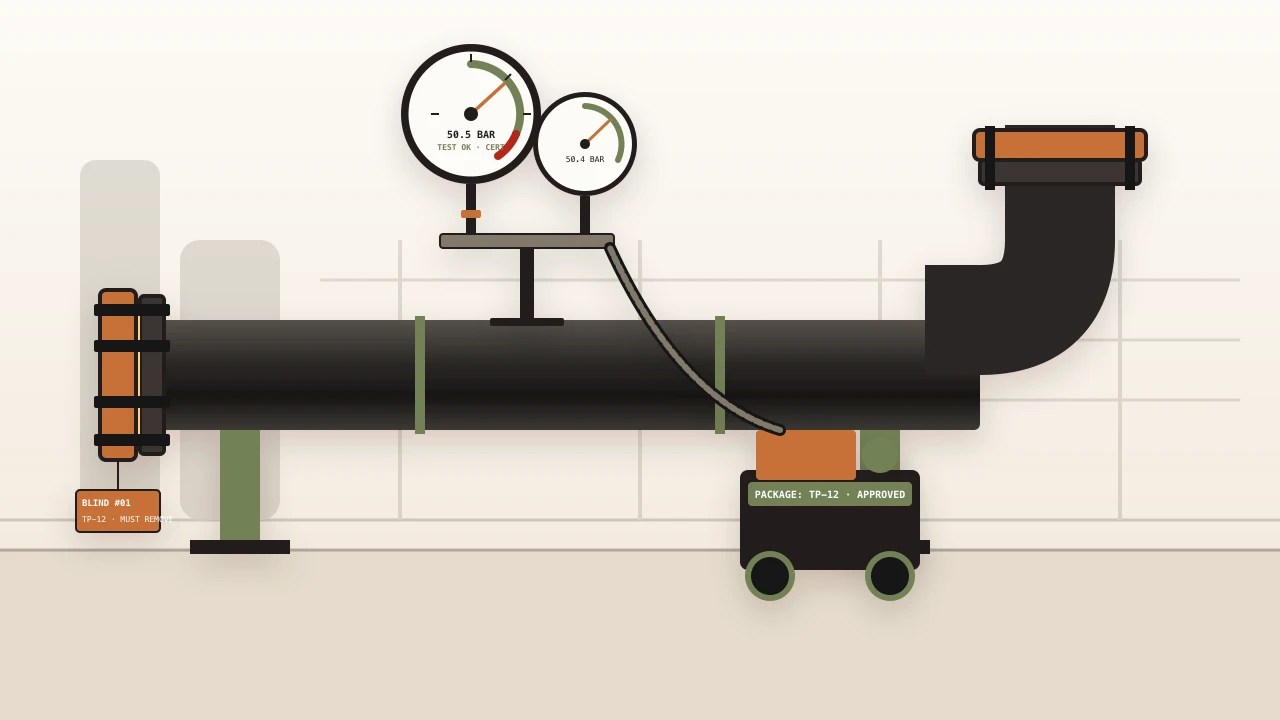
Connected lines are grouped into a test pack and hydrotested together. In-line equipment is isolated with test blinds so pressure does not damage it. After testing, every installed blind must be removed and accounted for.
On drawing. The line joined test pack TP-12 with blinds on both ends. Every blind placed must be cleared.
03 · Why it breaks
Today every party keeps its own file and passes data by email, phone or paper. With PipeQC everyone writes to one database, and the system draws the conclusions.
Today · everyone has a file
✕ data is lost: the reject never reached the shop, blockers surfaced on test day
With PipeQC · one database
04 · How the product works
Each party works in its own module, and everyone writes to one database. Project rules apply everywhere, and NDE serves both the shop and the site.
SETUP
SPOOLING
Who works: spooling engineer
GateA row that contradicts reference data does not become work
hands over spools to the shop →
FABRICATION
Who works: shop subcontractor · QC engineer
GateA spool is released only when material is verified, all joints and supports are recorded, and inspection and heat treatment are closed
hands over spools to site →
ERECTION
Who works: erection subcontractor · QC · owner inspector
GateReadiness is not set by hand: welded, on supports, inspection and heat treatment closed
hands over lines into a pack →
TEST PACK
Who works: test coordinator · blind and walkdown crews
GateA pack is not admitted to test while any readiness condition is open
NDE
REPORTS
05 · Reports and dossier
PipeQC builds the registers and the handover dossier from current data. The same set comes in XLSX for work and PDF for signing and archive.
Every weld: WPS, welder stamps, NDE, PWHT and heat numbers.
Every inspection obligation: method, batch, laboratory, result and report.
Category X punch items by test pack, open and closed.
Packs, test medium and pressure, readiness and dates.
Pack composition, test act, weld history, NDE and punch items.
06 · Rollout